Will AI Take My Job? Here Are 10 Things You Should Know

“Will AI take my job?” is a reasonable question. It is also difficult to answer with a simple yes or no. Artificial intelligence is already changing how some work gets done, but a change to a job is not always the same as the loss of a job.
A useful place to start is with the work itself: the tasks, decisions and relationships that make up a working day. Here are ten things to keep in mind.
1. A job is a bundle of tasks
Most jobs involve more than one kind of work. A receptionist might answer routine questions, welcome visitors, manage a diary and handle a sensitive conversation. A warehouse worker might follow a route, check a delivery and deal with an unexpected problem.
AI may be able to help with some tasks and not others. The International Labour Organization’s 2025 research brief describes jobs as bundles of tasks and stresses that potential exposure to generative AI is not a forecast of job losses.
That distinction matters. A technology can change part of a role without replacing the person who does it.
2. Exposure does not mean replacement
The ILO estimates that about one in four workers worldwide is in an occupation with some degree of exposure to generative AI. It also finds that transformation is more likely than full redundancy for most jobs. Its highest exposure category, where the potential for automation is greatest, accounts for 3.3% of global employment.
These are estimates of what the technology might be able to do, not predictions of what every employer will adopt. Cost, reliability, regulation, workplace priorities and the need for human input all affect what happens in practice.
A task may be technically possible to automate and still be done by a person, for good practical reasons.
3. A job can change profoundly without disappearing
Imagine that an AI tool drafts routine replies or prepares a first version of a report. A worker may still review the material, correct errors, talk to customers and take responsibility for the result. The job remains, but the rhythm and judgement it requires may change.
That can be a meaningful change. It might make a task less tedious, or give a worker less time to make decisions for themselves. The outcome depends partly on how the tool is introduced and what an employer expects people to do with it.

4. The effects will vary from job to job
Work that is digital, repeatable and easy to check may be easier to support with AI than work that depends on physical presence, trust or responding to unusual circumstances. But no simple rule divides “safe” occupations from “at-risk” ones. The same job title can cover different tasks in different workplaces.
Even within a single working day, some duties may be readily assisted while others depend on experience and local knowledge. A system might suggest the quickest delivery route; a driver still has to deal with a closed road, a difficult entrance or a customer who needs a little patience.
5. Saving time does not settle who benefits
A tool might help someone complete a task more quickly. What happens next is a separate question.
Perhaps the worker uses the time to check quality, help a colleague or speak with a customer. Perhaps the workload expands, or the saved minutes become a reason to expect more work from fewer people. The technology alone does not decide.
If AI saves five hours a week, who owns those five hours? The answer depends on decisions about workload, staffing and working conditions, not just on what the software can do.
6. Entry-level work deserves attention
Some early-career roles involve tasks that AI can assist with: preparing a first draft, gathering background information or organising routine data. If employers rely on AI for more of this work, people starting out may have fewer chances to learn by doing it themselves.
That does not mean those roles will vanish. It does raise a practical question for employers and workers: if a tool takes over a beginner task, where will the learning and experience come from instead?
A good transition should make room for people to build judgement, not simply expect them to arrive with it.
7. The quality of a job can change as much as its title
AI may alter the pace of work, how closely it is monitored and how much discretion a worker has. It may help someone make sense of information, or it may encourage an organisation to standardise every step.
These changes can be hard to see in a headline about jobs created or lost. They may show up in the ordinary details: fewer pauses between tasks, more time spent checking automated decisions, or less freedom to handle a familiar problem in a different way.

8. Human strengths still matter, but they are not a guarantee
Listening carefully, understanding a particular situation, building trust and taking responsibility are valuable parts of many jobs. So are practical skills and the ability to respond when events do not follow a plan.
But it would be too simple to say that these qualities make any job immune to change. AI can support work that involves human interaction, and employers may still reorganise roles around it. The better question is often not “Is my job safe?” but “Which parts of my work need human judgement, and how might the rest change?”
9. You can explore AI without treating it as a verdict
If AI is relevant to your work, start with one routine, low-risk task. Try it with information that is not confidential. Compare its result with the way you would normally do the task, and check the output before relying on it.
Notice more than whether it is fast. Is it accurate enough? Does it create extra checking? Does it help you do better work, or only more work? These small observations can give you a clearer picture than broad claims about what AI will do to an entire profession.
If you manage a team, include workers in decisions about how tools are introduced. The people who do the work often know where a system may help, and where it may cause trouble.
10. The choices around AI are part of the story
New technology does not arrive with a single, fixed effect on working life. Decisions by employers, workers, policymakers and communities influence whether it supports people, narrows their choices or does some of both.
This is one reason I wrote The Hours We Keep: Ordinary Lives in the Artificial Intelligence Revolution. The book follows a fictional family and a rock band through the small changes that accumulate around work, time and everyday life. AI is present the way weather is present: sometimes disruptive, sometimes barely noticed, but difficult to ignore.
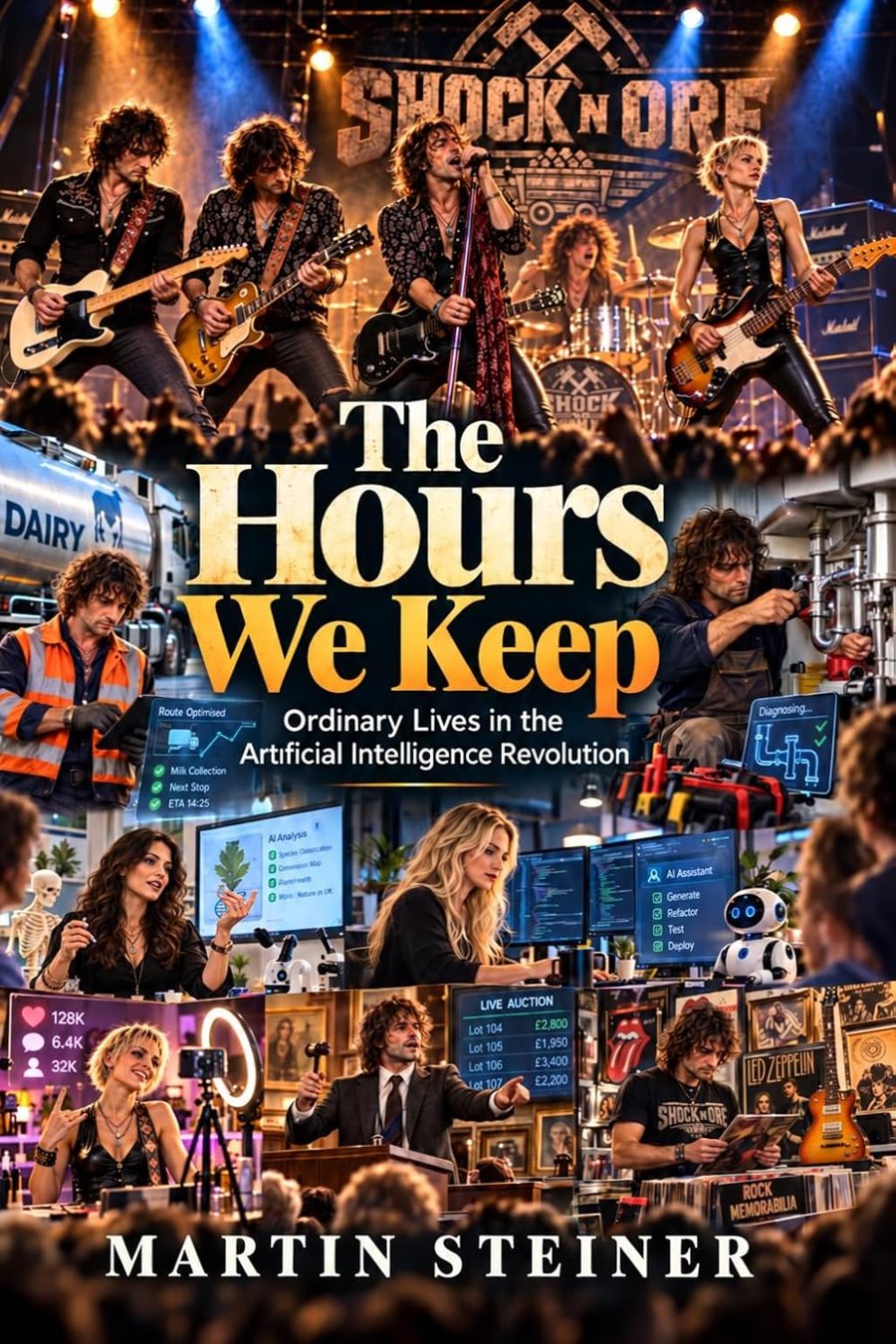
The book is available as a Kindle edition and a paperback, and you can find more of my writing on my author page.
So, will AI take your job?
It may take over some tasks. It may change what employers ask of you, how your work is measured or what you need to learn. In some workplaces, roles may shrink or disappear; in others, AI may help people do different work or do existing work differently.
No one can promise that a particular job will remain unchanged. But neither does exposure to AI mean that replacement is inevitable. For now, it may be more useful to look closely at the tasks in your own working day, and to ask who gets to decide what happens when those tasks change.
#TheHoursWeKeep #AIandWork #FutureOfWork #ArtificialIntelligence #OrdinaryLives